ISO9001认证专业光学元件制造商&供应商
服务热线:177 4349 1921 admin@ytoptics.com

产品分类
联系我们


首页 > 产品展示 > 晶体 > 被动调Q开关晶体
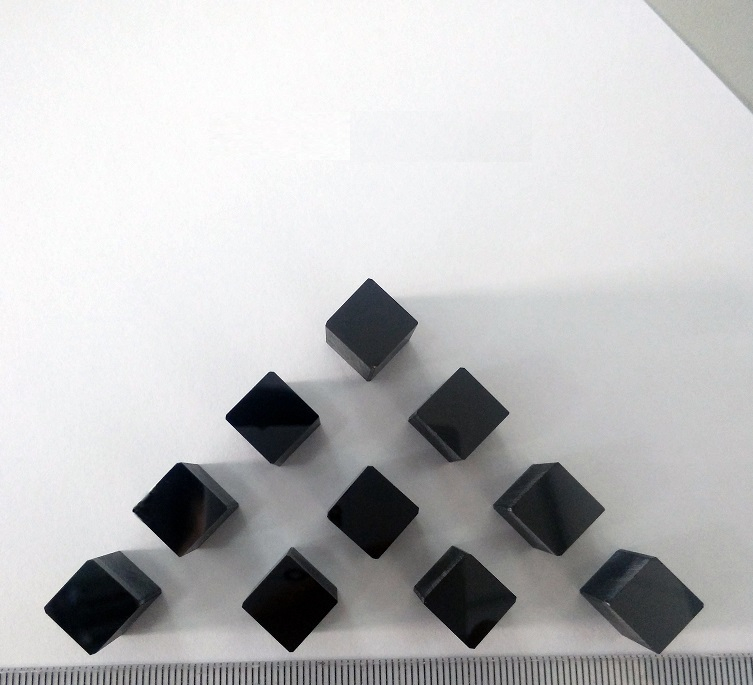
定制被动调Q开关晶体
Highly Recommended Passive Q-switch Crystals List from Yutai Optics: Passive Q-switch Cr4+:YAG Crystals; Passive Q-Switch V:YAG Crystals; Passive Q-switch Co2+:MgAl2O4 Crystals.
立即咨询
Cr4+:YAG is an ideal material for passive Q-switching of Nd:YAG and
other Nd and Yb doped lasers in the wavelength range of 0.8 to 1.2 mm.
One of the remarkable features of Cr4+:YAG is high damage threshold
(better than 500 MW/cm2 ). Passive Q-Switching is preferred for
simplicity of manufacturing and operation, low cost and reduced system
size and weight.
The crystals of Yttrium-Aluminum Garnet (YAG) doped with three-valence vanadium V3+ in tetrahedral position is relatively new material for passive Q-switching. V:YAG has working as efficient Q-switch for lasers operating in the 1.0~1.5 µm region. The absorption band between 1.0~1.5 µm is attributed to 3A2 →3T2 transition of V3+ ion in tetrahedral position of garnet lattice. Concentration of V3+ in tetrahedral position is controlled by growth and annealing conditions. The efficient Q-switching of lasers operating at both 1.064 and 1.3 micron has been obtained with a number of active mediums such as Nd:YAG, Nd:YVO4, Nd:KGd(WO4)2 under flashlamp and laser diode pumping.
Co2+:MgAl2O4 is a relatively new material for passive Q-switching in lasers emitting from 1.2 to 1.6 μm, in particular, for eye-safe 1.54 μm Er:glass laser, but also works at 1.44 μm and 1.34 μm wavelengths. Spinel is a hard, stable crystal that polishes well. Cobalt substitutes readily for magnesium in the Spinel host without the need for additional charge compensations. High absorption cross section (3.5×10⁻¹⁹ cm2 ) permits Q-switching of Er:glass laser without intracavity focusing both with flash-lamp and diode-laser pumping. Negligible excited-state absorption results in high contrast of Q-switch, i.e. the ratio of initial (small signal) to saturated absorption is higher than 10.
The crystals of Yttrium-Aluminum Garnet (YAG) doped with three-valence vanadium V3+ in tetrahedral position is relatively new material for passive Q-switching. V:YAG has working as efficient Q-switch for lasers operating in the 1.0~1.5 µm region. The absorption band between 1.0~1.5 µm is attributed to 3A2 →3T2 transition of V3+ ion in tetrahedral position of garnet lattice. Concentration of V3+ in tetrahedral position is controlled by growth and annealing conditions. The efficient Q-switching of lasers operating at both 1.064 and 1.3 micron has been obtained with a number of active mediums such as Nd:YAG, Nd:YVO4, Nd:KGd(WO4)2 under flashlamp and laser diode pumping.
Co2+:MgAl2O4 is a relatively new material for passive Q-switching in lasers emitting from 1.2 to 1.6 μm, in particular, for eye-safe 1.54 μm Er:glass laser, but also works at 1.44 μm and 1.34 μm wavelengths. Spinel is a hard, stable crystal that polishes well. Cobalt substitutes readily for magnesium in the Spinel host without the need for additional charge compensations. High absorption cross section (3.5×10⁻¹⁹ cm2 ) permits Q-switching of Er:glass laser without intracavity focusing both with flash-lamp and diode-laser pumping. Negligible excited-state absorption results in high contrast of Q-switch, i.e. the ratio of initial (small signal) to saturated absorption is higher than 10.

 |
|
|
|
|